
A season in fast-forward - Harvest 2026

Updated: Oct 8
A season in fast-forward
2026 was a growing season unlike any we have experienced at Pinglestone Estate.
After one of the wettest winters in UK history, budburst arrived early. Spring then brought its own challenges, with a prolonged frost window that saw 19 nights below 0°C between 1st April and 16th May, including a treacherous late frost on 13th May. Flowering began around 12th June and, from there, the season accelerated.
The summer of 2026 proved to be the hottest the UK has experienced on record, bringing five heatwaves, 40 days above 30°C and 11 weeks without meaningful rainfall. Between 1st June and 3rd September, the vineyard received 15% more solar radiation than during the same period in 2025 – itself, remarkably, the previous warmest and sunniest year on record.
The fruit had reached similar sugar and acidity levels by 24th August 2026 to those we recorded on 24th October 2024.
Two months' difference is quite extraordinary.
As our vineyard is dry-farmed, with no irrigation, a year of drought has brought into greater focus the importance of our underlying chalk.
Chalk allows effective drainage while also storing thirst-quenching water within its fine pores, providing a valuable reserve that vine roots can draw on during prolonged dry conditions.
A compressed growing season brings opportunities, but also challenges. It asks us to make prudent viticultural decisions and, perhaps more importantly, to resist treating the vineyard as one homogeneous entity. A simplistic blanket approach does not work on our nuanced vineyard tapestry.
All of this plays into the curiosity and fascination of getting to know the distinctive traits of individual parcels, as we seek to connect with our site more deeply and farm accordingly.
A tailored approach
With temperatures regularly climbing into the mid-30s, canopy management became particularly important.
Leaf removal around the fruit zone helps improve airflow and exposes the bunches to sunlight, but in a summer such as this, too much exposure can be detrimental. Our approach therefore was tailored to each block and its aspect, selectively removing leaves while retaining protection on the afternoon side of the canopy, where the grapes would otherwise have been exposed to the strongest heat of the day, increasing the risk of sunburn.
It is a small example of the sort of decision-making process that has characterised this season. What works in one block, or indeed one year, cannot simply be replicated in another. Rather, it calls for intimacy and insight, intellect and intuition.
The unprecedented conditions required us to continually assess and adapt our viticultural strategy. Huge credit must go to the entire Pinglestone team – permanent and seasonal – for the exceptional quality of fruit that arrived at the winery.
An early harvest for an extraordinary year
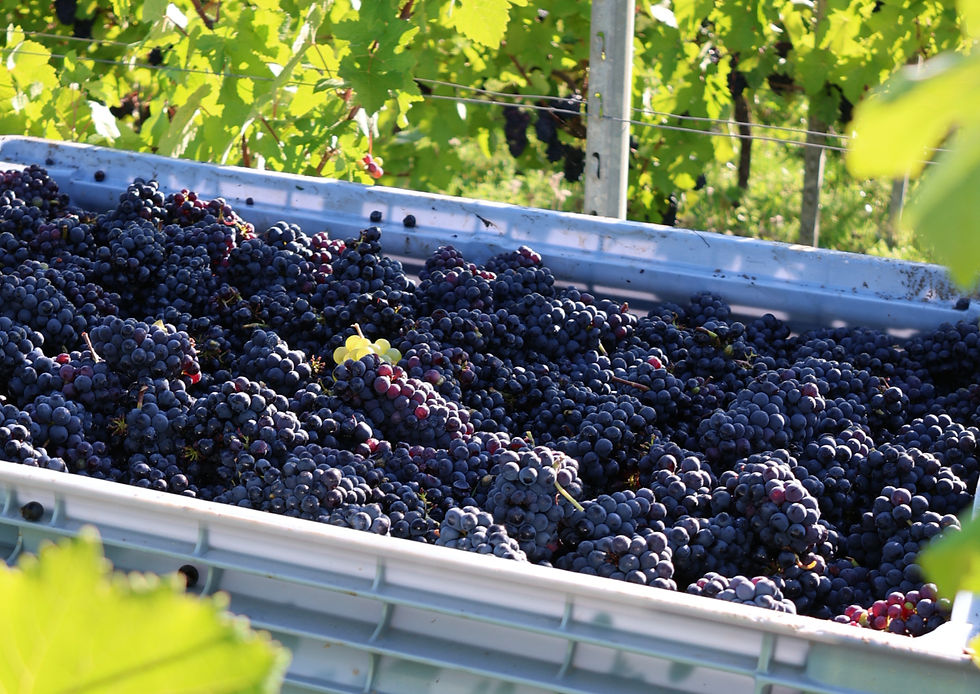
Harvest began on 1st September, our earliest on record, with Pinot Noir the first fruit to come through the winery doors. Chardonnay, Pinot Meunier and Pinot Gris followed suit and rather neatly, Pinot Noir also brought harvest to a close.
Grapes from the vineyard’s unique pockets of personality were hand-picked and kept separate in the winery, affording each parcel the space to express itself fully. Handling each block individually continually refines our understanding of Pinglestone and allows us to capture a true reflection of our wonderful single-estate mosaic.
The early harvest inevitably brought logistical challenges of its own. Everything happened sooner – and within a considerably tighter window – than we are accustomed to. But an early harvest also brings opportunity, giving us more time post-harvest for critical vineyard operations and to follow the wines carefully as they begin their journey in the winery.
Our intention is always to retain the elegance and freshness that define the Louis Pommery style, while allowing the character of Pinglestone and the individual growing season to reveal itself. The combination of ripeness, fruit quality and the aromatic spectrum we have seen this year gives us much to be excited about.
From harvest to cellar
With the grapes safely harvested, attention has now moved to the winery.
Fermentations are healthy and ticking along nicely, and we expect them to finish over the coming weeks.
Chardonnay clone 76 from our Fork Road Church Block is showing poise and finesse, carrying alluring citrus and white floral notes. Our Adonis Block Pinot Noir clone 777 expresses vibrant red summer fruits, dancing along a balletic acid line. Alresford Hill Meuniers are starting to build structure and complex textural layers, whilst our Pinot Gris is offering stone-fruit aromas and palate depth.
It is still far too early to draw conclusions about the finished wines – there is a long creative journey ahead – but first impressions give us plenty of reason for optimism.
After a year of extremes – from a sodden winter and spring frosts to record-breaking heat and drought – it is fascinating to see what 2026 has given us.
For now, the vineyard can exhale.
In the winery, we watch, wait and look forward to seeing what this extraordinary vintage becomes.
We welcome you to join us on that journey.



Comments